New York, NY

Challenge:
Presenting digital art in Times Square means competing with one of the most aggressive visual environments in the world — a space defined by consumption, speed, and constant stimulation.
The challenge was to create a work that did not fight this context, but instead used it as material. Creative Deli needed to feel familiar enough to belong within the commercial logic of Times Square, while quietly subverting it. The goal was not spectacle for its own sake, but a conceptual intervention that questioned value, labor, and meaning within digital systems.
Our Approach:
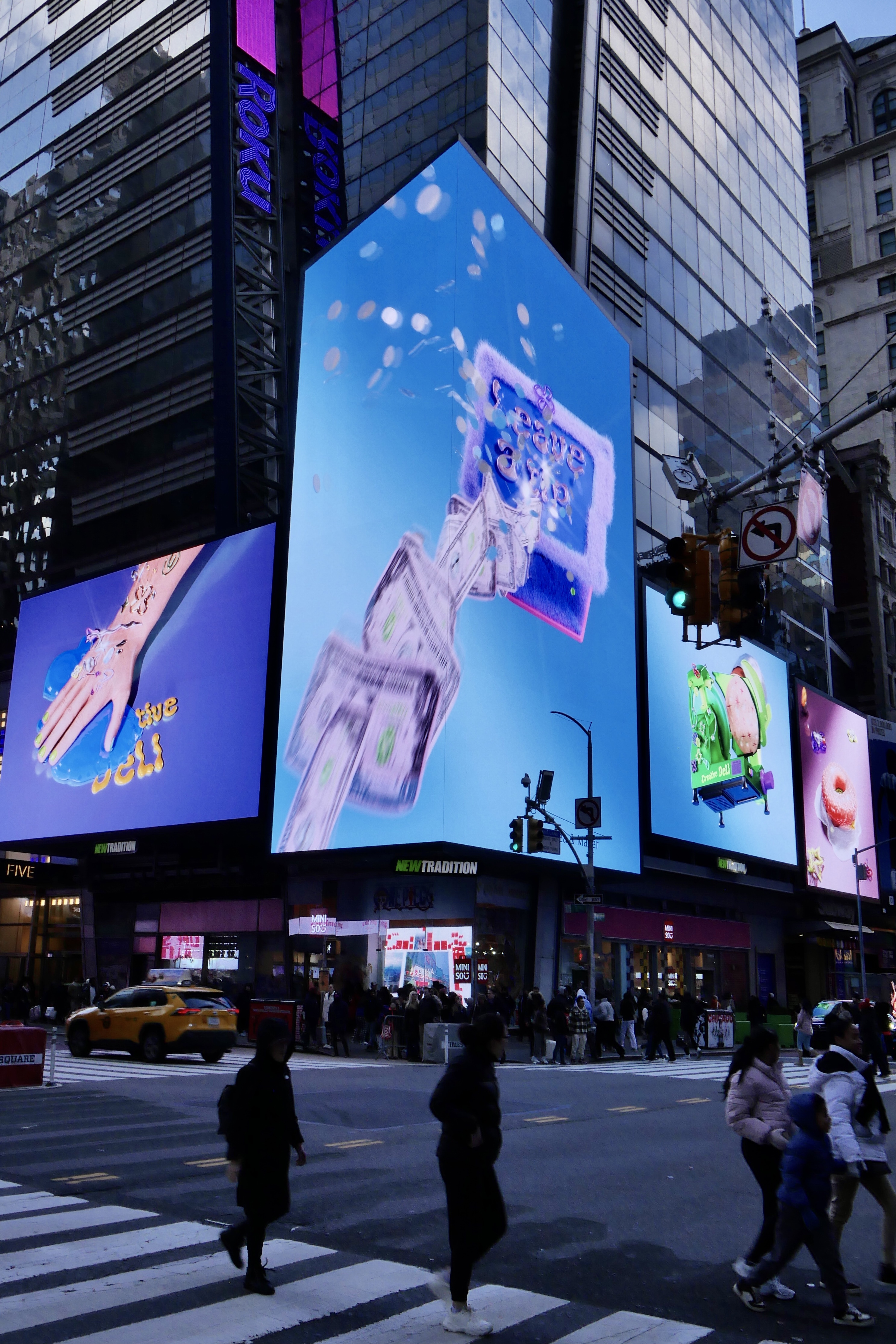
We constructed a fictional digital deli as a self-contained system — a familiar environment operating entirely within digital rules. Rather than focusing on a single action, the space unfolds through four artworks running simultaneously, forming a place that feels active, functional, and complete.
A custom-built digital meat slicer repeatedly cuts through digitalized ham, turning a familiar task into a continuous visual gesture. Alongside it, a bagel assembly explores the materiality of digital food — how texture, movement, and form behave once food exists purely as image and data. A “Leave a Tip” POS mirrors everyday gestures of exchange using a fictional currency, while a roach-killing moment introduces a small, personal interaction that feels immediate and decisive.
Ingredients remain recognizable yet exaggerated, functioning as visual metaphors rather than food. Actions unfold smoothly and with intention, not to produce a physical outcome, but to sustain the operation of the space itself. In the context of Times Square — a place defined by visual consumption — Creative Deli exists as a place where digital goods are prepared, displayed, and shared without ever needing to exist physically.



Results & Impact
Presented as part of Skyline Stories, the work entered one of the most saturated visual environments in the world and chose to operate within it rather than compete against it.
By adopting the familiar language of consumer spaces, the work blended seamlessly into its surroundings while quietly reframing them. Viewers encountered the piece as they would any other digital display — yet its pace, gestures, and interactions invited a moment of pause and recognition.
Creative Deli transformed a place built for constant exchange into a space for observation, where digital production became something to watch, consider, and experience. In doing so, the work elevated everyday digital gestures into a shared public moment — subtle, accessible, and reflective within the flow of the city.